Showing posts with label #conquistadores. Show all posts

Sunday, November 22, 2020

Hernán Cortés & Diego Velazqez concept characters

    Haciendo recapitulación de mis personajes hasta ahora recreados he caído en cuenta que Hernán Cortés no cuenta hasta ahora, en mis entradas del blog, con su respectivo estudio de cabeza, ni de vestuario. En su momento me detuve en el análisis de los diferentes retratos que se tiene de él y como se pensaba que era, y algunos flashlights de mi versión del conquistador pero no el desarrollo del mismo https://fortenochtitlan.blogspot.com/2014/09/the-final-hernan-cortes-el-hernan.html

    Por tal motivo lo retomo para completarlo y presentároslo como debe ser. Aquí os adelanto los dibujos de su head study, la armadura final elegida y su casco.


Además, en primicia también, os adelanto el desarrollo en lápices del antagonista de Cortés en la primera etapa de su devenir; el gobernador de Cuba de entonces, don Diego Velázquez de Cuellar.

Allí os dejo eso....


***

    Reviewing the characters I have recreated so far, I have realized that Hernán Cortés does not have his head studio or wardrobe in my blog entries. At the time I focused in the analysis of the different portraits of him and how he was thought to look, and some flashlights of my version of the conqueror but not the development of the same https://fortenochtitlan.blogspot.com/2014/09/the-final-hernan-cortes-el-hernan.html

    For this reason I take it back to complete it and present it to you as it should be. Here I advance you the drawings of his head study, the final armor chosen and his helmet.


    But, in addition, I also advance you the development in pencils of the antagonist of Cortés in the first stage of his becoming; the governor of Cuba at that time, Don Diego Velazquez de Cuellar.
There I leave you that....


Saturday, June 1, 2019

El Príncipe Cacamatzin / Prince Cacamatzin Concept Art

    Aquí os dejo el concept character para el personaje del príncipe rebelde Cacamatzin (más conocido entre los castellanos como Cacama). Fue tlatoani de Texcoco  y sobrino de Moctezuma (México).

    Hijo de Nezahualpilli y nieto de Nezahualcóyolt su madre era hermana de Moctezuma. A la muerte de su padre en 1516 Cacamatzin disputó el trono a sus hermanos Ixtlitxóchitl y Coanacochtzin, y gracias al apoyo de su tío pudo alzarse con el poder de Texcoco, antigua ciudad nahua, que superaba en esplendor a Tenochtitlán, pero los mexicas la habían convertido en su satélite tras la confederación de la TripleAlianza. 


    En base a los diseños de la anterior entrada de este blog
y a  otras fuentes históricas como el Códice Ixtlilxochitl he desarrollado este atuendo y aspecto para un señor dentro de la jerarquía Mexica.

    Los diseños del extremo del maxtlatl (taparabos) y de los brazaletes están inspirados del Códice Borgia y del libro de Pasztory Aztec Art.

    Y como en el caso de Moctezuma concept art, su tiara lleva el diseño del glifo para la ciudad de Texcoco realizado en mosaico de turquesa e incrustaciones de oro y coral.

    Es sabido que los tilmatli, las capas que vestía todo varón mexica, eran piezas de vestir anudadas sobre el hombro derecho o al frente y que, en el caso de los nobles y altos dignatarios, estaban hechas en algodón y profusamente diseñadas a base de plumas multicolores, conchas, piedras preciosas, vivos colores y estampados de sellos, placas de jade, y otros materiales preciosos. 


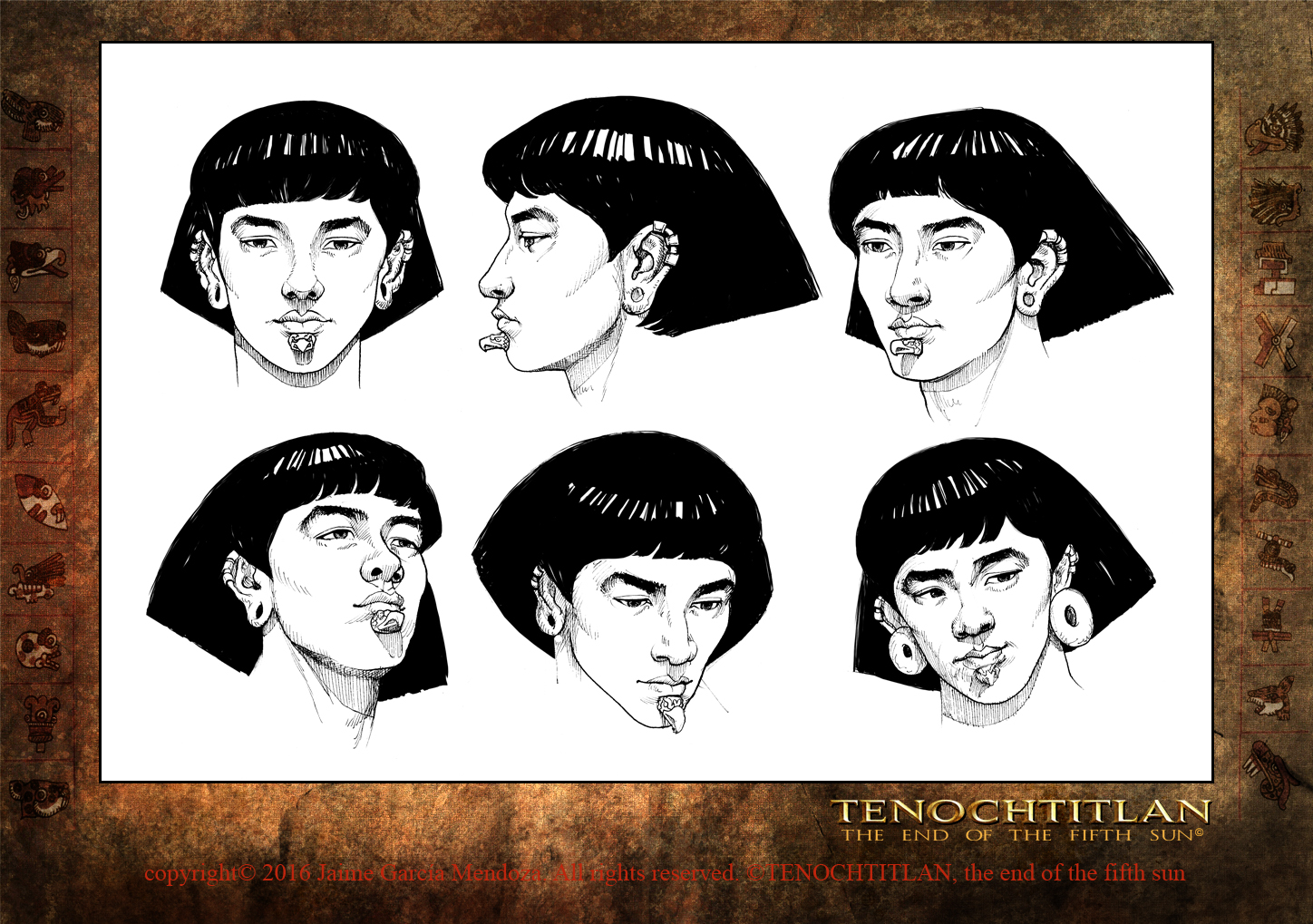
    Como he mencionado en anteriores entradas la pieza labial o bezote que llevaban los hombres de la nobleza y reyes decidí hacerla opcional por cuestiones de diseño. En el caso de Cacamatzin, la  incorporé en su diseño para reflejar un carácter rebelde e impetuoso apelando a las criterios actuales. Realizada en oro tiene la forma de la cabeza de un águila, símbolo de la realeza mexica, de ambición y dinamismo frente a la dubitativa actitud de si tío Moctezuma.

***

    Concept character for the rebel prince Cacamatzin (Cacama as spaniards called him), Lord of Texcoco and Motecuhzoma nephew.

    Son of Nezahualpilli and grandson of Nezahualcóyolt his mother was Motecuhzoma sister. When his father die in 1516 Cacamatzin disputed the throne against his brothers Ixtlitxóchitl and Coanacochtzin.  Due his uncle support he can took the power of that ancient nahua city, that overcome Tenochtitlan in splendor but the Mexicas kept it as satelite city after the Triple Alianza confederacy.


    Based on designs of my previous spot on
and other historic sources as Codex Ixtlilxochitl I develop this attire and look for a prince in the Mexica hierarchy.

    The maxtlatl (loinclothe) end edge design and bracelets are inspired in Codex Borgia and the book of Pasztory, Aztec Art.

    As well as Motecuhzoma concept art, the tiara design represent the Texcoco city gliph made in turquoise mosaics with gold and coral scales.

    As known that tilmatli, the coats worn every mexica men, was pieces tie over the right shoulder or in front and, in the case of noblemen and high dignataries, was made in cotton and lavishly designed with colorful feathers, shells, gemstones, vivid colors and seals prints, jade plates, and others precious materials.


    As noted on previous spots the underlip piece or bezote worn by the nobilty and kings I decide to be optinal depending the character and intention of design. In this case I used because Cacamatzin, as rebel, younger and impetuous man must wear, as be used in our time. Made in gold have a eagle shape head, mexica royal symbol, ambition and dynamism representation by contrast his uncle Motecuhzoma hesitant behavior.

Friday, May 10, 2019

Banners en preparación / Banners in work

    Retomando el trabajo donde lo deje aquí les comparto un par de dibujos a lápiz de los siguientes banners; los de Cacamatzin y Pedro de Alvarado. Pronto pasaré las tintas de los concepts de Cacamatzin y así completar el ciclo.

Pincipe Cacamatzin
Pedro de Alvarado


    Taking back the work in the point I leave here bring you a couple of drawings for the prince Cacamatzin and Pedro de Alvarado banners. Soon you can see the inks for the concept character of Cacamatzin in order to complete the cycle.

Thursday, May 2, 2019

Comics III

    Después de estar un año ausente cuesta lo suyo retomar las cosas donde las dejé. Ahora estoy revisando el guión, las innumerables carpetas de imágenes y texto que poseo para saber donde está cada cosa. Una labor muy compleja que retomo con gran entusiasmo deseando llevar a buen puerto este proyecto.

    Y más aun después de comprobar que el interés de los seguidores se mantiene a pesar de este lapsus. Algunos preguntándome para cuándo va a estar lista la novela, otros felicitándome por mi arte... Y otros, como el señor David Nievas, administrador de la pagina de Facebook "La Conquista de Mexico" el cual amablemente me solicitó algunos de mis trabajos para ilustrar sus artículos ( https://www.facebook.com/groups/273154999966224/ ). Desde aquí agradezco profundamente su interés por  mi trabajo.

    Esta pagina está resultando una gran fuente de información histórica y documental así como también de referencias visuales que puedo utilizar para este proyecto. Y en este sentido debo indicar también que el señor Nievas me ha hecho una agradable revelación; la novela gráfica "Aztec Empire", escrita por Paul Guinan, y dibujada por David Hahnhttps://www.bigredhair.com/books/aztec-empire/about/ , https://twitter.com/AztecEmpire1520?lang=es ).


    Hasta ahora solo llevan cuatro capítulos los cuales he leído y debo indicar que me ha gustado. Es un trabajo muy colorido, dinámico y luminoso, con una narración fluida y explicativa, bien documentada, y que hasta ahora no lo había visto en otras publicaciones sobre el tema y que he mencionado en entradas anteriores. ¡Bravo por el trabajo de estos señores!

    Todo esto me indica que el tema de la conquista de Mexico está en el aire y que hay mucho interés sobre el mismo, lo que me dice que no estoy desencaminado del todo, como un colega me señaló una vez: "A nadie le interesa ya la conquista de Mexico"...

***

    After one year have posting no entry in this blog take a lot of work take things back againg. I'm cheking the script, the countless image and reference folders I have to known where is every thing. A complex task that I eagerness reassume with  in oreder to fulfill this project. 

    And even more I realize many people and friends keep the interest on it despite my absence. Some people asking me when it will be finished, others congratulating for my work... And others as mister David Nievas, Facebook administrator page "The Conquest of Mexico", who kindly  asked me permission to upload some images and drawings to illustrate his articles ( https://www.facebook.com/groups/273154999966224/ ). I must to thank him the inteerest shown on my work.

    His page is a great historic and documental information source as well as visual reference I can use to my project. In this way I must to appointment that mister Nievas made me a pleasant revelation; the graphic novel "Aztec Empire", written by Paul Guinan and illustrated by David Hahn https://www.bigredhair.com/books/aztec-empire/about/ , https://twitter.com/AztecEmpire1520?lang=es ).


    At this moment they have published only four chapters already I'd read and must to say  it 's very colourful, dynamic and fresh, with a very fluently and descriptive narration, well documented, as no others comics and graphic novels before, and I'd mention in previous post. ¡Great work, gentelmen!

    All this show me that the Conquest of Mexico is a topic still running in the air, that interest to many people, and that I'm going in the path, as one day somebody tell me: "Nobody care about the Conquest of Mexico today"...

Wednesday, October 8, 2014

Teotihuacan in Madrid / Teotihuacan en Madrid

      Between all the Mesoamerican cultures had influence on Mexica people we have that of Teotihuacan, City of Gods. As much in culture as in art aspects this ancient metropolis, even ancient in Aztecs time, had a great importance to Mexica; was a reference civilization as too a pilgrimage point because they believed that in this city borned the Fifth Sun and the gods whom bring It to life.
 
      Scholars like Pasztory find Teotihuacan artistics evidences in the mexica art and even there are archeologics evidences which demostrate that the aztecs accomplish excavations on Theotihuacan, as too in the Tula city, in the way to import art pieces of all kind to reused or to offerings in their temples and sanctuaries.
 
      For that reason when a archeologic exhibition about Teotihuacan came to Madrid I visit it to pick up some graphic material as references to my Project considering the enormous influence that this ancient city had on the Mexica Art and look.
 
Stone lintel with polychome jaguar figure
     
      Although is true that in Theotihuacan are found several terracotta figures like this,...


... even bigger tan this one,...

 
... the major form of art was the mural painting. In this exhibition we had the privilege to see of first hand the beautiful frescoes with vivid colours and sinuous and richess forms.
 
 
Frieze frescoe with painting representing the Feather Serpent
 
Detail with the Feather Serpent head. The similarity with the Chinese dragon is noticeable
 
Maybe I can use this iconographic references to decorate the walls of my Tenochtitlan palaces, and temples, you don't?
 
      We found other several interesting pieces like obsidian knifes and dart heads;...


particular jewellery pieces like that composed with tooths and coral, and greenstones;...


this interesting decorate seashell;...


  and some pieces of pottery like this precious glass...


***
 
      Entre las culturas y civilizaciones que precedieron a los mexica en Mesoamérica, y que influenciaron a estos en muchos aspectos de su cultura, se encuentra la sagrada Teotihuacan. Ciudad ya antigua en tiempos de los aztecas Teotihuacan fue un punto de referencia y peregrinaje, ciudad donde se creía había nacido el Quinto Sol y los dioses que le dieron origen.
 
      Estudiosos como  Pasztory han encontrado evidencias del arte teotihuacano en las manifestaciones artísticas mexicas e incluso vestigios arquelógicos que demuestran que los aztecas excavaron en Teotihuacan, al igual que en Tula, para importar piezas de arte de toda índole para reutilizarlas u ofrecerlas como ofrendas en sus templos y santuarios.
 
      Por ello al presentarse en Madrid una exposición temática sobre esta antiquísima ciudad no puede dejar de ir recoger referencias gráficas para este proyecto teniendo en cuenta la influencia de Teotihuacan en el arte mexica y sus aspecto.
 
Dintel pétreo con figura de jaguar esculpida y policromada
     
      Si es cierto que en Teotihuacan se han hallado figuras en terracota como estas,...


incluso tan grandes como esta...,


... la más característica forma de manifestación artística de esta urbe era la pintura mural. En esta exposición tuvimos el privilegio de ver de primera mano los bellos frescos de vívidos colores, y sinuosas y ricas formas.


Friso pictórico representando a la Serpiente Emplumada


Detalle con cabeza de la Serpiente Emplumada. El parecido con el dragón chino es notable.
Probablemente utilice toda esta referencia pictórica para decorar los muros de palacios y templos de mi Tenochtitlan, no?

      También encontramos piezas tan interesantes como cuchillos y cabezas de flecha de obsidiana de caprichosas formas;...


particulares collares compuestos de dientes y corales, y piedras verdes;...


... esta interesante caracola decorada;...


y piezas de alfarería preciosamente realizada...


Thursday, September 25, 2014

The Aztec Warrior, Sketches / Guerreros Aztecas, Bocetos

      I show you now several mexica warrior sketches and notes focus on the militar attire with some civil dress of high rank captains and generals. This are some testies to take contact with its iconic representation. This drawings are inspired on Osprey publication illustrations but too on the mexica codex Matricula de Tributos 1 made in 1520-1530, and on others bibliographic and iconographic sources.
Matrícula de Tributos (Tribute Roll)

      In this image we can see some warrior suits or tlahuiztli, shields and helmets tributed by vassal towns to Mexico-Tenochtitlan. The rectangles below show severals tilmatli (cloack) designs.

Studies for Mexica Warrior; top, a Cuextecatl priest warrior and Jaguar and Eagel warrior  sketches

Mexica warrior studies; left a simple soldier; Eagel Warrior in action, and Jaguar Warrior with banner
      The mexica warrior on the left ilustrate a simple soldier who wear the ichcahuipilli or cotton-quilted armor over the torso, the shield (the chimalli) and the macahuitl or wood club with obsidian blades; the basic aztec armament.

Mexica nobleman head study. At right a Eagle Warrior or Cuauhpilli sketch

Eagle and Jaguar Warrior sketches and a Papalotl warrior with militar attire, and civil dress with cloack
      The image left below show a Jaguar Warrior or Ocelopilli with his complete armor. Beside is the same warrior with civil clothe; over his shoulder wear the tilmatli own of his rank and status. At the right we see a Papalotl warrior (warrior whom had capture three prisioners) bearing the papalotl banner, a butterfly made in paper and reed.

Motecuhzoma sketch and Cuextecatl soldier in militar and civil attire

1. The Matrícula de Tributos (Tribute roll) is a 16th-century mexica codex listing the tribute paid by the various tributaries of the Aztec Empire. The codex show hundreds of tribute glyphs listed in it. It's considered an important document in learning about Nahuatl and Aztec culture, mathematics, governance, economy and geography.
Take from Wikipedia http://en.wikipedia.org/wiki/Matr%C3%ADcula_de_Tributos


***

      Os presento ahora una serie de bocetos y anotaciones sobre el atuendo mexica, en concreto con la parafernalia militar, y algunos vestidos civiles de los militares de alto rango. Son pruebillas para ir relacionándome con su representación. Están basados en las ilustraciones de Osprey pero también en la Matricula de Tributos 1, códice mexica compuesto entre 1520 y 1530, y en otras fuentes bibliográficas/iconográficas que poseo.
Matrícula de Tributos

      La imagen arriba muestra una página de la Matricula de Tributos donde se recoge los bienes impuestos enviados a Mexico-Tenochtitlan por sus estados vasallos. En medio vemos diferentes armaduras o tlahuiztli con sus correspondientes tocados o yelmos, escudos y estandartes. Debajo los rectángulos representan los mantos o tilmatli con variados diseños.

Estudios para guerreros mexica; arriba un Cuextecatl, y  bocetos de guerreros Águila y Jaguar

Guerreros mexica; izquierda soldado raso; guerrero Águila en acción, y guerrero Jaguar con estandarte
      El guerrero de la izquierda lleva el ichcahuipilli, la armadura de algodón reforzado, el chimalli o escudo, y el macahuitl (macana de madera con hojas de obsidiana afiladas); el armamento básico de los aztecas.

Estudio para cabeza de noble mexica. A la derecha; anotación para un guerrero Águila


Bocetos para guerreros Águila y Jaguar. Derecha; guerrero Papalotl en traje militar y civil
     La imagen inferior izquierda muestra anotaciones para un guerrero Jaguar o Ocelopilli con su armadura completa. a un lado lo muestro con atuendo civil llevando el tilmatli  o manto con diseños propios de su rango y estatus social. A la derecha tenemos al guerrero Papalotl (rango que indica que ha capturado ya tres prisioneros en guerra); porta a sus espaldas el estandarte papalotl, representación mexica de una mariposa hecha de papel y cañas.

Anotación sobre Moctezuma y un guerrero Cuextecatl en traje militar y civil

1. Matrícula de tributos: Sus fuentes provienen de varios códices originales copiados por los tlacuilos (pintores de códices) o que alguna de sus partes fuese obra original de los indígenas especialistas en esta actividad, donde se registra las tributaciones hechas al Estado Mexica por los pueblos sometidos.
Tomado de Wikipedia http://es.wikipedia.org/wiki/Matr%C3%ADcula_de_Tributos