Showing posts with label #conquest of Mexico. Show all posts

Saturday, June 1, 2019

El Príncipe Cacamatzin / Prince Cacamatzin Concept Art

    Aquí os dejo el concept character para el personaje del príncipe rebelde Cacamatzin (más conocido entre los castellanos como Cacama). Fue tlatoani de Texcoco  y sobrino de Moctezuma (México).

    Hijo de Nezahualpilli y nieto de Nezahualcóyolt su madre era hermana de Moctezuma. A la muerte de su padre en 1516 Cacamatzin disputó el trono a sus hermanos Ixtlitxóchitl y Coanacochtzin, y gracias al apoyo de su tío pudo alzarse con el poder de Texcoco, antigua ciudad nahua, que superaba en esplendor a Tenochtitlán, pero los mexicas la habían convertido en su satélite tras la confederación de la TripleAlianza. 


    En base a los diseños de la anterior entrada de este blog
y a  otras fuentes históricas como el Códice Ixtlilxochitl he desarrollado este atuendo y aspecto para un señor dentro de la jerarquía Mexica.

    Los diseños del extremo del maxtlatl (taparabos) y de los brazaletes están inspirados del Códice Borgia y del libro de Pasztory Aztec Art.

    Y como en el caso de Moctezuma concept art, su tiara lleva el diseño del glifo para la ciudad de Texcoco realizado en mosaico de turquesa e incrustaciones de oro y coral.

    Es sabido que los tilmatli, las capas que vestía todo varón mexica, eran piezas de vestir anudadas sobre el hombro derecho o al frente y que, en el caso de los nobles y altos dignatarios, estaban hechas en algodón y profusamente diseñadas a base de plumas multicolores, conchas, piedras preciosas, vivos colores y estampados de sellos, placas de jade, y otros materiales preciosos. 
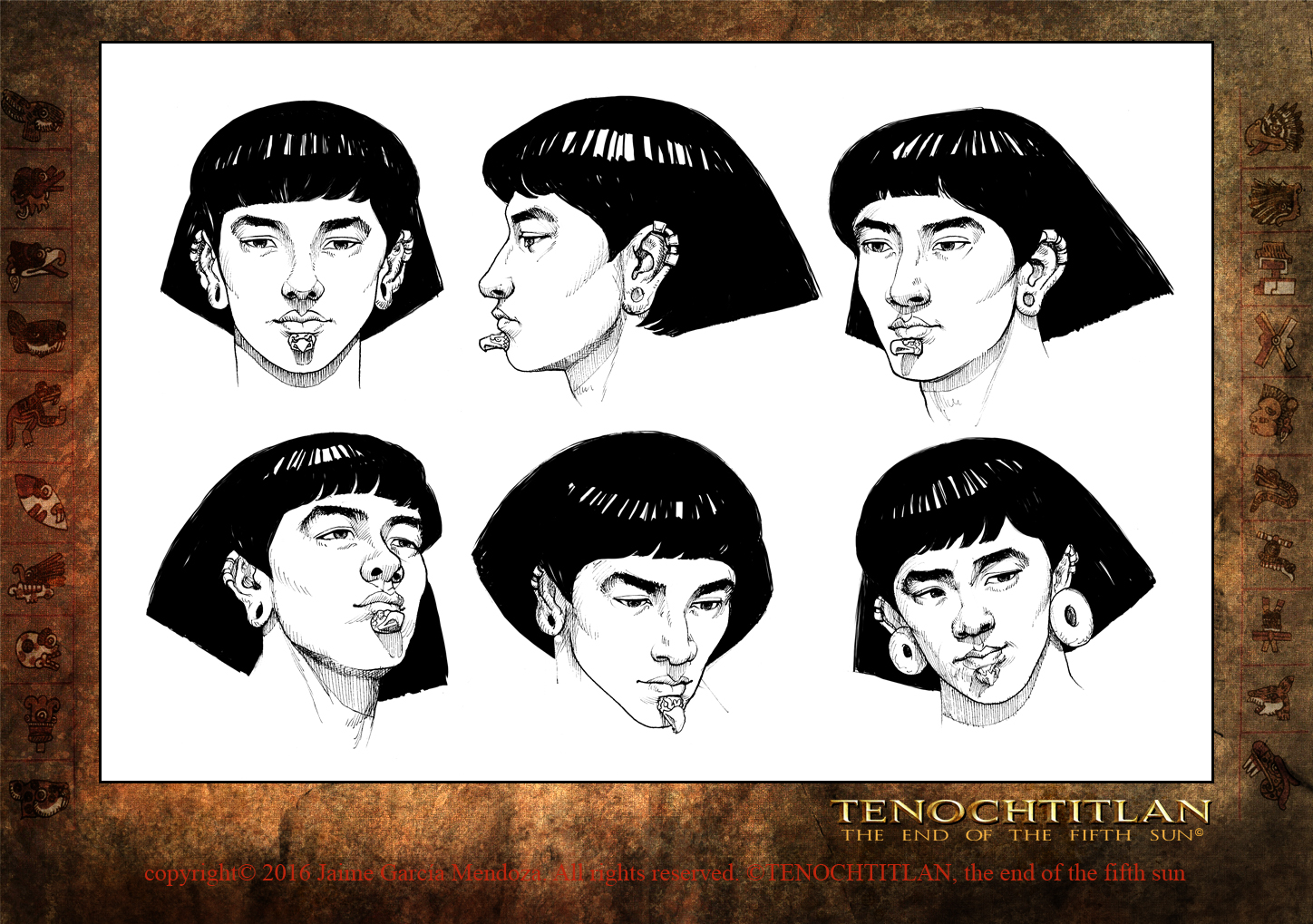

    Como he mencionado en anteriores entradas la pieza labial o bezote que llevaban los hombres de la nobleza y reyes decidí hacerla opcional por cuestiones de diseño. En el caso de Cacamatzin, la  incorporé en su diseño para reflejar un carácter rebelde e impetuoso apelando a las criterios actuales. Realizada en oro tiene la forma de la cabeza de un águila, símbolo de la realeza mexica, de ambición y dinamismo frente a la dubitativa actitud de si tío Moctezuma.

***

    Concept character for the rebel prince Cacamatzin (Cacama as spaniards called him), Lord of Texcoco and Motecuhzoma nephew.

    Son of Nezahualpilli and grandson of Nezahualcóyolt his mother was Motecuhzoma sister. When his father die in 1516 Cacamatzin disputed the throne against his brothers Ixtlitxóchitl and Coanacochtzin.  Due his uncle support he can took the power of that ancient nahua city, that overcome Tenochtitlan in splendor but the Mexicas kept it as satelite city after the Triple Alianza confederacy.


    Based on designs of my previous spot on
and other historic sources as Codex Ixtlilxochitl I develop this attire and look for a prince in the Mexica hierarchy.

    The maxtlatl (loinclothe) end edge design and bracelets are inspired in Codex Borgia and the book of Pasztory, Aztec Art.

    As well as Motecuhzoma concept art, the tiara design represent the Texcoco city gliph made in turquoise mosaics with gold and coral scales.

    As known that tilmatli, the coats worn every mexica men, was pieces tie over the right shoulder or in front and, in the case of noblemen and high dignataries, was made in cotton and lavishly designed with colorful feathers, shells, gemstones, vivid colors and seals prints, jade plates, and others precious materials.


    As noted on previous spots the underlip piece or bezote worn by the nobilty and kings I decide to be optinal depending the character and intention of design. In this case I used because Cacamatzin, as rebel, younger and impetuous man must wear, as be used in our time. Made in gold have a eagle shape head, mexica royal symbol, ambition and dynamism representation by contrast his uncle Motecuhzoma hesitant behavior.

Friday, May 10, 2019

Banners en preparación / Banners in work

    Retomando el trabajo donde lo deje aquí les comparto un par de dibujos a lápiz de los siguientes banners; los de Cacamatzin y Pedro de Alvarado. Pronto pasaré las tintas de los concepts de Cacamatzin y así completar el ciclo.

Pincipe Cacamatzin
Pedro de Alvarado


    Taking back the work in the point I leave here bring you a couple of drawings for the prince Cacamatzin and Pedro de Alvarado banners. Soon you can see the inks for the concept character of Cacamatzin in order to complete the cycle.

Thursday, May 2, 2019

Comics III

    Después de estar un año ausente cuesta lo suyo retomar las cosas donde las dejé. Ahora estoy revisando el guión, las innumerables carpetas de imágenes y texto que poseo para saber donde está cada cosa. Una labor muy compleja que retomo con gran entusiasmo deseando llevar a buen puerto este proyecto.

    Y más aun después de comprobar que el interés de los seguidores se mantiene a pesar de este lapsus. Algunos preguntándome para cuándo va a estar lista la novela, otros felicitándome por mi arte... Y otros, como el señor David Nievas, administrador de la pagina de Facebook "La Conquista de Mexico" el cual amablemente me solicitó algunos de mis trabajos para ilustrar sus artículos ( https://www.facebook.com/groups/273154999966224/ ). Desde aquí agradezco profundamente su interés por  mi trabajo.

    Esta pagina está resultando una gran fuente de información histórica y documental así como también de referencias visuales que puedo utilizar para este proyecto. Y en este sentido debo indicar también que el señor Nievas me ha hecho una agradable revelación; la novela gráfica "Aztec Empire", escrita por Paul Guinan, y dibujada por David Hahn ( https://www.bigredhair.com/books/aztec-empire/about/ , https://twitter.com/AztecEmpire1520?lang=es ).


    Hasta ahora solo llevan cuatro capítulos los cuales he leído y debo indicar que me ha gustado. Es un trabajo muy colorido, dinámico y luminoso, con una narración fluida y explicativa, bien documentada, y que hasta ahora no lo había visto en otras publicaciones sobre el tema y que he mencionado en entradas anteriores. ¡Bravo por el trabajo de estos señores!

    Todo esto me indica que el tema de la conquista de Mexico está en el aire y que hay mucho interés sobre el mismo, lo que me dice que no estoy desencaminado del todo, como un colega me señaló una vez: "A nadie le interesa ya la conquista de Mexico"...

***

    After one year have posting no entry in this blog take a lot of work take things back againg. I'm cheking the script, the countless image and reference folders I have to known where is every thing. A complex task that I eagerness reassume with  in oreder to fulfill this project. 

    And even more I realize many people and friends keep the interest on it despite my absence. Some people asking me when it will be finished, others congratulating for my work... And others as mister David Nievas, Facebook administrator page "The Conquest of Mexico", who kindly  asked me permission to upload some images and drawings to illustrate his articles ( https://www.facebook.com/groups/273154999966224/ ). I must to thank him the inteerest shown on my work.

    His page is a great historic and documental information source as well as visual reference I can use to my project. In this way I must to appointment that mister Nievas made me a pleasant revelation; the graphic novel "Aztec Empire", written by Paul Guinan and illustrated by David Hahn ( https://www.bigredhair.com/books/aztec-empire/about/ , https://twitter.com/AztecEmpire1520?lang=es ).


    At this moment they have published only four chapters already I'd read and must to say  it 's very colourful, dynamic and fresh, with a very fluently and descriptive narration, well documented, as no others comics and graphic novels before, and I'd mention in previous post. ¡Great work, gentelmen!

    All this show me that the Conquest of Mexico is a topic still running in the air, that interest to many people, and that I'm going in the path, as one day somebody tell me: "Nobody care about the Conquest of Mexico today"...

Saturday, August 2, 2014

The Battle for Tenochtitlan... / La Batalla por Tenochtitlan...


      ... is about to begin!
      Here I lend you this very little project presentation teaser. I hope you enjoy it!

                                                                          ***

      ... está a punto de EMPEZAR.
      Aquí os dejo un pequeñísimo teaser de presentación de mi proyecto. ¡Espero lo disfrutéis!

Wednesday, July 30, 2014

TENOCHTITLAN, the end of the Fifth Sun / TENOCHTITLAN, el fin del Quinto Sol


The Castilians: concept character banner sketches for ©TENOCHTITLAN-2012
      At the moment to start to write something we must choice the title, thing no always easy to do. In this project seem to be logic the option "the Conquest of Mexico" because this is the matter of the story. 
      Nevertheless this title is so well-known, so usual and logic that seem like a assertion of the conquest as a war fact in favor of the winners. I don't want that. As I say my intention is to be the most impartial as possible and present the two factions as they was in the moment to bring face to face. So I keep searching and waiting for a good title. 
      "Hernán Cortés" was another title prospect but, like the previous one, it was partial and trite. It is no a bio about the conquistador although he is a kind of conductor thread of the graphic novel. This is owing to my intention to throw light to this character in the way we go back to the Cortés youth to known from where he were and how he was before he appear on the Mexico Gulf and become the Conqueror of Tenochtitlan. 
      "Conquistadores" maybe work but it is partial too so it was reject. As well this title was used for a movie project and for a recent graphic novel. 
      Maybe I find some suggestion on nahualt language, somethingh the name of a god or a ritual as Mitton's "Quetzalcoatl" or "The God of Rain....", "Aztecs" but if I do that I'll become partial as with the early examples. I must to find something that have in common both side if the factions, but, what? 
      Suddenly here the solution; what conquest Hernán Cortés? What defend the mexica? Where developed the most part of the plot? The answer is clear: the great city of Tenochtitlan! As well the castilians as the aztecs fight for the city of thousand bridges. Was the dream of some, the first and authentic El Dorado. Was the sacred city of the powerful and frighteners mexica, the center of their universe, the door of the aztecs three worlds, their proud and their symbol. And to me a great challenge; to recreate that mithical lake city in all its splendor and magnificence, their perfect grid street system, their canal, their bridges, their temples and palaces, their imponent Sacred Precinct... 

The Aztecs: concept character banner sketches for ©TENOCHTITLAN-2012
      So I'd put to my comic "TENOCHTITLAN, the End of the Fifth Sun". To aztecs was Tenōchtítlān. To Castilian was Temixtitlán, Temixtitán, Tenustitlán, Tenuchtitlán.... To the rest is Tenochtitlán, with accent in the last syllable. Nevertheless I write Tenochtitlan, without accent, showing the name place emerge from the mingle between the nahua and spanish language.

***
 
Los Castellanos: bocetos para banners con personajes de ©TENOCHTITLAN-2012
 
      A la hora de empezar una escrito siempre hay que elegir un título, cosa no tan fácil como parece. Y dada la naturaleza de la historia no tenía otra opción que "La Conquista de México". Por que de eso va, ni más ni menos. 
      Sin embargo esto quedaba tan trillado, tan usual y lógico e incluso parecía una afirmación de la acción bélica de conquista a favor de los vencedores. Y yo no quería eso. Como expliqué arriba mi propósito era ser lo más imparcial posible y presentar a los dos bandos tal cual estaban en el momento del encuentro. Así que decidí seguir buscando y esperar a que surgiera un buen título. 
      "Hernán Cortés" fue otro título que barajé pero, al igual que con el anterior, resultaba parcial y manido. No se trata de una biografía de Hernán Cortés aunque es cierto que este personaje es el hilo conductor de la novela. Pero esto se debe a que quería lanzar más luz sobre este extremeño por lo que nos trasladamos a años antes de la Conquista de Tenochtitlan, en su juventud, y conocer de dónde provenía y cómo era antes de aparecer por las costas del Golfo de Mexico. 
      Busqué por la web alguna sugerencia y me llamó la atención un proyecto de película del mismo tema que se iba a llamar "Conquistadores". Este proyecto al parecer no cuajó. Y ese título para mi comic book tampoco. 
      Miré también algún nombre en nahualt, como el de algún dios o algo parecido pero no lo veía fiable ya que tambien pecaría de ser parcial. Tenía que conseguir algo imparcial algo que compartieran en común ambos bandos. Que significara para ambos lo mismo y que por igual los involucrara, amén que resultase novedoso, fuerte, impactante y de una sola palabra, como el "Quetzalcoatl" del frances Mitton. 
      Y claro, eh aquí la solución; ¿qué conquistó Hernán Cortés? ¿Qué defendieron los mexica? ¿Dónde se desarrolla la mayor parte de la historia? Pues en estas preguntas está la respuesta: ¡la gran ciudad de Tenochtitlán! Tanto los castellanos como los mexica pelearon por la ciudad de los mil puentes. Fue el sueño de unos, el primer y verdadero El Dorado que tanto se afanaron los conquistadores que vinieron después. Fue la sagrada ciudad de los poderosos y temidos mexica, el centro del universo azteca, la puerta entre los tres mundos, su orgullo y su símbolo. Y para mi un gran reto; recrear la mítica ciudad lacustre con su cuadrículadas calles, sus canales, sus puentes, sus templos y sus palacios, su gran Teocalli...  

Los Aztecas: bocetos para banners con personajes de ©TENOCHTITLAN-2012
      Así que bautice, aun a pesar de lo díficil que puede resultar al principio quedarse con el nombre, "TENOCHTITLAN, el Fin del Quinto Sol" a mi novela grafica. Para los aztecas era Tenōchtítlān. Para los castellanos Temixtitlán, Temixtitán, Tenustitlán, Tenuchtitlán.... Para otros es Tenochtitlán, con acento agudo. Sin embargo yo la he puesto Tenochtitlan, sin acento, mostrando así el toponimio resultante entre la lengua nahua y la castellana.

Monday, July 28, 2014

Demo: "The Battle of Bridges" / Demo: "La Batalla de los Puentes"


      This decision brings as consequence that the story become more extensive and the vignette grow up in number. Tell a story just with the action in the tablets and the dialog demand a picture series similar to a storyboard cartoon. And is at the end that this graphic novel was conceived as a movie; each sequence as if I had watching in a cinema screen. I saw in my head and immediately translate it in words. Even I used music parameters to develop some sequence in the way I can give rhythm to moments like this one, "The Battle of Bridges" (well known as "La Noche triste") or this other "Naumaquia" (the naval battle in the Texcoco lake).
La Noche Triste (The Sad Night), illustration by J. Redondo
      The next demo is a visual example of how I saw this sequence from "The Battle of Bridges". The rhythm of the music gives me the images which sprout in my mind and I began to articulate the action according to the music. The soundtrack is from the anime Katsuhiro Otomo's AKIRA conducted by Yamashiro Shoji   and performanced by the group Geinoh Yamashirogumi. To me is the best soundtrack for an anime movie, very original, interesting, suggestive and rare.
      This demo is very rustic. I'd use the images of the miniatures to make it so maybe you not understand what is happen so I give you some clues.
      Begin with a panoramic vision on lake Texcoco, over the Tacuba causeway. The Spaniards and they allies, womans, childrens, prisoners and the gold, carried over mules, running away from the city under a weak rain. They take with them portable bridges to save the causeway keyhole.
      They trying to make no noises. The rain help them in the night flight. The thunder illuminated the sky and they put the first bridge. They cross over, following the straight causeway, to the next keyhole. The operation is repeated and the second bridge fall over the keyhole. They cross the second bridge, faster but in silence.
      And when the column midpoint of spaniards and allies are crossing the bridge one of the tlaxcaltecas warrior think to listen a sound like drums. In the black horizon a few lights seeing. Suddenly that lights become more and more and the sound of the drums is more loud and loud. And then that lights go up surprisingly. Thousand of them. The ally shout: Mexicah! The horror and fear destroy the formation and panic settle in the causeway. Everybody run to the bridge meanwhile hundred of canoes full in Cuauhtli and Ocelotl warriors come faster from both sides of the causeway.
      The warriors jump into the causeway and the attack start. No mercy, no prisoners. In the escape and madness, when the mules crossing the bridge with the gold cargo, it break by the middle under the weight of the animals. The mens, blind by panic, can't stop and a river of bodies fall onto the water, one pushed by others and so. The last shot are the mules sinking, perishing, like the mens, dragging by the weight of the Emperor fifth part.
"The Battle of the Bridges" demo
 
***

      Esta decisión trajo como consecuencia  que la historia se alargara y las viñetas crecieran en número. Contar una historia solo con la acción de las  viñetas exigía una secuencia de cuadros muy parecida a un storyboard. Y es que este cómic está concebido como si fuese una película; concebí cada secuencia como si lo estuviese viendo en la pantalla de una sala de cine. Las iba mirando tal cual en mi cabeza y así las fui montando. Incluso utilicé parámetros musicales para desarrollar secuencias lo que me ayudó a darle ritmo a ciertos momentos como por ejemplo en la "Batalla de los Puentes" (conocida popularmente como "La Noche Triste") o la "Naumáquia" (la batalla naval de Texcoco).
"La Noche Triste", ilustración de J. Redondo
      Como ejemplo de ello os remito al video demo de la primera. Este es una muestra de cómo me inspiró la banda sonora de la película de animación japonesa "AKIRA" para articular dicha secuencia (una banda sonora compuesta y dirigida por Yamashiro Shoji  e interpretada por el grupo Geinoh Yamashirogumi y que considero una de las mejores y más originales que se han hecho para este género).
      Es un demo muy rústico, en base a las miniaturas pero no podía esperar a realizarla para ver qué tal quedaba y si funcionaba realmente. Esto me ayudará incluso a corregir ciertas viñetas para que funcione mejor la secuencia de acción.
      Las imágenes tal vez no se comprendan por lo que os voy a dar algunas pistas.
      El demo empieza con una panorámica sobre el lago Texcoco. Vemos la recta calzada de Tacuba. Es de noche y cae una suave llovizna. Los españoles y sus aliados indios junto a las mujeres, los niños, algunos rehenes y la recua de mulas cargadas con el oro, salen silenciosos de la ciudad. Llevan también sendos puentes portátiles para salvar los ojos de la calzada.
      Van en silencio, ayudados por el rumor de la lluvia. Un rayo ilumina el cielo mientras colocan trabajosamente el primer puente. Lo cruzan y se dirigen al siguiente ojo de calzada. Se repite la operación y colocan el puente. Lo cruza, rápido pero en silencio.
      Cuando la mitad de la columna en fuga va cruzando el puente se oye un lejano rumor. Un aliado tlaxcalteca se detiene y presta atención. El rumor es como de tambores. En el horizonte, negro como la pez, el aliado ve unas luces que empiezan a multiplicarse. Crecen en número como crece el sonido de los tambores. De improvisto las luces se elevan en el cielo nocturno. Son miles de luces. El guerrero grita: Mexicah! El horror y el miedo destruye la formación y el pánico acampa en la calzada. Todos corren al puente mientras cientos de canoas cargadas de feroces guerreros Aguila y Jaguar se acercan desde ambos lados de la calzada.
       Los guerreros saltan a la calzada y el ataque empieza. No hay piedad, no hay prisioneros. En la huida y la locura, cuando las mulas cruzan con su valioso cargamento, el puente se parte por la mitad bajo el peso de los animales. Los hombres, ciegos de miedo, no pueden frenarse y caen cual rio de cuerpos, a las aguas del lago, unos sobre otros, empujándose a la muerte.
      La última escena es la de las mulas hundiéndose en las aguas arrastradas por el peso del quinto de Su Majestad.
"La Batalla de los Puentes", demo
 

Wednesday, July 23, 2014

Neither Victims Nor Executioner / Ni Víctimas ni Victimarios


      In the same way as the Conquistadores happen with the Aztecs, whom I prefer call Mexica. Motecuhzoma weakness, lack of resolution and mettle to face up to the foreigners is a point that still now reproaches him. This graphic novel will demystify the Huey Tlatoani eternal role as melancholic and daydreamer giving another possible reasons for his strange behaviour based on investigations, studies and much reflexions about the psyche not just of the mexica emperor as well as all aztecs; their way as they religion, politic and universe influence in the final result.

 
      And all this from a historical point of view, no judging the protagonist with ours moral and ethics parameters, if not from their world, their epoch, their century. And always having in consideration that is just to understand, not justify the facts. Neither victims nor executioner.

      Is here where I assume the discloser role, a documentalist that investigate and compile data from several sources, contemporaries and actuals, biographies, academic studies, chronics and stories, weighing, contrasting, to later join the parts in a single product.  I get away from prejudice, distortioned versions, partials, twisted, build up throughout centuries of bitterness, manipulations and negative legends in favour of political goals. Making less evil to some and increase the value of the others all as I can and in its just measure.

El Abrazo, Jorge González Camarena, 1908 - 1980
      
      So is for this reason that I decided no use the "captions". This comic element always involve a narrator, someone who can be a partial point of view. This decision set out a new challenge; I had to tell the story only with the images and the dialog and this will be very complicated.
      I want no use the "Suddenly", "Then", "Later", etc. As visual artist I wanted that the vignette explained and related the plot by itself. I want that the reader look the vignette, understand the drawings, the action developed in it, listening the voice of the characters whom bring the required information about the story, and follow them throughout the tablets. A very risky business but I decided assume it. 

***
      Igual pasa con los aztecas, a los que prefiero llamar mexica. Moctezuma también se lleva otro palo por mostrar debilidad y falta de decisión y temple al momento de enfrentarse con el asunto de los extranjeros. Esta novela gráfica desmitifica el eterno papel del  melancólico y ensimismado Huey Tlatoani y ofrece las posibles causas de su extraño comportamiento basado en investigaciones, estudios y mucha reflexión sobre la psique no solo del emperador de los mexica sino también del pueblo mismo y su religión, su política y su manera de ver el mundo.

 
      Y todo esto considerando los hechos desde una perspectiva histórica, no juzgando a los protagonistas desde nuestros parámetros morales y éticos si no desde su mundo, su época, su siglo. Y siempre teniendo en cuenta que se trata de entender, no justificar. Ni víctimas ni victimarios.

      Y he aquí que mi labor entronca ya con la divulgación, de documentación y recopilación de datos de varias fuentes, tanto actuales como de la época, biografías, estudios, crónicas y relatos, sopesándolas, contrastándolas para luego unirlas en esta historia. He procurado alejarme de prejuicios, imágenes distorsionadas, parciales, desvirtuadas, acumuladas por siglos de resentimientos, de manipulaciones y de leyendas negativas en pro de fines políticos. Desatanizando a unos, y revalorizando a otros lo más posible y en su justa medida.

El Abrazo, Jorge González Camarena, 1908 - 1980
     
      De allí que una de las decisiones que tome al momento de empezar a escribir fue la de no utilizar las "cartelas o cartuchos" (caja de texto narrativo que explican ciertos hechos o cosas que los protagonistas o los dibujos no pueden). No quería que pareciese un cuento o una narración ya que este elemento implica un narrador y por lo cual una voz humana que podría ser tenida como elemento parcial. Esto, por consiguiente, planteaba un nuevo reto; narrar visualmente y por el diálogo los hechos que se desarrollan en las viñetas. Cosa que resultó muuuy complicada.
      No quería un "Entonces", "De pronto", "Más tarde", etc. Como artista visual deseaba que las mismas viñetas y lo que en ella hubiese explicase y narrase la historia. Que el lector mirase las viñetas, comprendiera los dibujos, la acción que en ellos sucede, que los mismos personajes den la información necesaria para el desarrollo de la historia. Y sé que esto puede ser altamente arriesgado, mucho, pero decidí afrontarlo.

Tuesday, July 15, 2014

Comics II


Now is the moment to evaluate the most ambicious comic book than I ever seen about the Conquest of Mexico, or I thought that at first glance. Jean Yves Mitton's "Quetzalcoatl" is what's more a great erotic fantasy than a comic about the Spaniards and the Aztecs. The theme is just a exotic background to present the misfortunes of Maiana, the main character (a kind of DoñaMarina / Malinalli / Malinche, the Hernán Cortés interpreter) whom happened everything, from the beginnig till the end like occured to Justine (the marquis de Sade's Juntine) but in mexican version, with Mesoamerica as scenography.
     Published by Glénat in 1998 this work is a graphic novel (7 volumes with 48 pages each book more or less) in which appears Cortés and Mutecuhzoma too but just as supporting actors. / Of merit is the art of Mitton; good landscapes, strong and round figures, and full details without been clashing. Mitton give a historical precision to his scenes and atrezzo characters result of a very conscientious documentation labour. I think that maybe he use as inspiration the interesting work of Anton Hoffman (1863 - 1938) who in  1919 wrote and published a adventures book that called "The Conquest of Mexico" (sure a really collection piece).
Anton Hoffman's aztecs warriors, 1919
Mitton's aztecs warriors look a certain resemblance to that of Hoffman. Have mention too his glossary at the end of each chapter with the nahuatl terms and words.

http://www.emudesc.com/threads/quetzalcoatl-7-tomos-jean-yves-mitton-espanol-bs-up-cbr.479582/

     Similar to the spaniard version it this Graphic Nonfiction collectible, this time in english. They number "Hernán Cortés" from 2005 was published by Book House / The Salariya Book Company Ltd.
Is a summarised version aimed to childrens by the format and text, wrote by David West and Jackie Gaff and the art of Jim Eldridge. The book presentation is not bad but maybe the drawings are some sloppy. Again we have a brief text, trample, fragmentary accompanied by the illustrations and helped by lot of big captions in the way it can be fit in its 43 pages.
     To my surprise, in France, and again by Glénat Publiser, went out for sale in 2012 "Conquistador" by Jean Dufaux as scriptwriter and Felipe Xavier as artista.

At present day there not are available versions in spanish or english so I do not read it yet and only can made a valuation for the cover art and some inner page samples: incredible drawing and design, good execution and color. Little more I can say about this work by Dufaux / Xavier except that a first glance the soldier in the cover is like the image of a classic spaniard Conquistador, with its morion helmet, some stabbed sleeve and in the inner pages some aztec pyramid no much exactly from the archeological point of view. But it is the less important, I guess. 
 
http://siguealconejoblanco.es/comics/comic-europeo/conquistador-1-de-jean-dufaux-y-felipe-xavier/
http://www.glenatbd.com/bd/conquistador-tome-1-9782723486590.htm  

     And to finish exist another version from 1993 in two volumes entitled "Cortez and the Fall of the Aztecs" published by Tome Press and written by Brent Truax and Mitch Waxman / Russ Braun art.
In the cover we can see Hernán Cortés (Cortez with Z maybe to give more dramatic quality to the character) as a ultra villain, ruthless look, and in some of the inner pages the famous scene with the  burning of the ships that belong more to the legend about the incident than what really happend.
     There are another versions relating to the matter, maybe with less reach and focus to childrens use, or to young people as the most of the comic books I'd mentioned before. There are correct, restrained, friendly versions, but at the same time provide a hieratic, schematic vision, faithful to the preestablished canon, that well know, superficial dealed, to accomplish the order, and well done of course. That Conquistadores are they of the portraits, with pose, with a single face, acting as we expecting using only one or two historic versions, or, as in other cases, get away from the texts, or using the facts as a exotic and historical background. Most of this comics are published in english or french, like the movies I'd mentioned in previous post, and the content is just a illustration of scripts based on historical text very summarized. The "Spanish Black Legend" flow in the background of its pages, spring whose origin was the work of a dominican spanish friar Bartolomé de las Casas, contemporary of the facts. His writings was embrace by France, and from there to the rest of the world interwine with the Equality, Freedom and Fraternity ideals.
Theodore de Bry. Illustration for the "Brevísima"; indians throw to dogs, XVIth century
      I felt in all this versions, the versions I'd read, a lack of rigour, deep and human approach to the theme, a sense of drama and the point of view of the other; the Mexica (aztecs) and they rich and complex world. If is more commercial that Cortés put fire to his ships, well, do it! My point is the demystification of the Conquista; in this expample Cortés don't put fire to his ships. I want to clean and release from topics this facts and personages, shed light on this part of the history of two worlds, understand how happened the Conquest of Mexico truly, and that of the Americas. A big task I imposed myself  because in a sense I feel this like a life debt.
     I'll like invite you to read the next article about the "Black Spanish Legend" just it is in spanish. If you can read it, go ahead, I recomended you because is very interesting:

http://www.abc.es/sociedad/20130303/abci-leyes-indias-derechos-humanos-201303012122.html


***
     Toca ahora la versión verdaderamente más ambiciosa que he visto con relación a la conquista de México, o por lo menos así me pareció en un primer momento. Y es que "Quetzalcoatl" de Jean Yves Mitton no es más que una gran fantasía erótica bien lograda ambientada en la Mesoamérica de la conquista aunque esto no es el tema del relato. Glénat publica esta novela gráfica, ya que su formato lo es (7 tomos de 48 páginas aproximadamente cada uno), en 1998 aunque no sé por qué pensé que era más antiguo.
Es una especie de Justine (la Justine del Marqués de Sade) a la mexicana donde a su protagonista, Maiana, la pasa de todo, de principio a fin. Vamos, que aunque salga Moctezuma y Cortés, no va de la conquista tal cual.
     Meritoria es la labor gráfica de Mitton; consigue unos buenos paisajes, figuras rotundas y fuertes, y cantidad de detalles sin perder la claridad. Mitton recrea a sus personajes y el entorno con mucha corrección histórica, fruto de una labor de documentación amplia. Cosa curiosa es que para muchos de sus guerreros mexicas probablemente se basó en las figuras de Anton Hoffman (1863 - 1938) quien en 1919 escribió y publicó un libro de aventuras que tituló "La Conquista de México" (una verdadera pieza de colección).
Anton Hoffman's aztecs warriors, 1919
También merece mención su glosario de términos y palabras en nahuatl que coloca al final de cada tomo.
http://www.emudesc.com/threads/quetzalcoatl-7-tomos-jean-yves-mitton-espanol-bs-up-cbr.479582/

     Luego encontré en la web otra colección como las españolas presentadas arriba pero esta vez en inglés; Graphic Nonfiction: "Hernán Cortés" del 2005 por Book House / The Salariya Book Company Ltd. Es una obra resumida enfocada a un público infantil escrita por David West y Jackie Gaff con dibujos de Jim Eldridge. Y aunque el proyecto no está mal se demerita por un dibujo algo descuidado.
Tenemos otra vez una serie de ilustraciones que acompañan a un texto más bien fragmentario y que enlaza secuencias por medio de cantidad de enormes cajas de leyendas para soportar la narración y acabarla en 43 páginas.
     Para mi sorpresa en 2012, en Francia, y otra vez de mano de la Editorial Glénat, salió a la venta "Conquistador" de Jean Dufaux como guionista y Felipe Xavier, dibujante.
Actualmente no hay traducción al inglés o al castellano así que no he podido leerlo y solo puedo juzgarlo por su aspecto, que me resulta fascinante; un dibujo increíble, contundente, bien realizado y coloreado. Poco más puedo decir por ahora de la obra de Dufaux / Xavier salvo que a primera vista tenemos la visión de un fuerte soldado con morrión, alguna manga acuchillada, y una enorme pirámide y centro ceremonial azteca no muy correcto desde el punto de vista arqueológico. Pero eso es lo de menos, supongo.
 
http://siguealconejoblanco.es/comics/comic-europeo/conquistador-1-de-jean-dufaux-y-felipe-xavier/
http://www.glenatbd.com/bd/conquistador-tome-1-9782723486590.htm

      Y para acabar existe otra versión en comic de 1993 en dos tomos titulada "Cortez and the Fall of the Aztecs" publicado por la editorial Tome Press escrita por Brent Truax y el arte de Mitch Waxman y Russ Braun.
En la cubierta vemos a un Hernán Cortés (Cortez, con Z para darle más fuerza) con pintas de ultra villano despiadado y en las viñetas interiores escenas como la quema de las naves que responden más a la leyenda que hay al respecto que a lo que realmente ocurrió.
    Hay otras versiones en cómic sobre el tema, tal vez de menor envergadura y dirigidos a un público muy infantil o juvenil como la mayoría de los comics que he mencionado y que he podido leer. Son versiones prudentes, amistosas algunas, pero hieráticas, esquemáticas, fieles al patrón ya establecido, de lo ya conocido, y tratadas por encima, como para cumplir, correctamente y bien hecho dentro del género. Son los conquistadores de los retratos, con un solo rostro, de pose, ilustrando los hechos según un par de versiones, o en otros casos alejándose de ellas bastante, o como fondo histórico y exótico. Y como ocurre con las películas, estos cómics son más abundantes en lengua inglesa. Son  ilustraciones de los relatos escritos, muy resumidos y con cierto trasfondo de la infame "Leyenda Negra" española cuyo germen brotó de las páginas del dominico Fray Bartolomé de las Casas, contemporáneo de los hechos, y que tuvo mucho eco en Francia, y de allí exportada al resto del mundo entrelazada con los principios de Igualdad, Libertad y Fraternidad.
Theodore de Bry, grabado para la "Brevísima": aperreamiento de indios, s. XVI
     Humildemente he sentido que en todas estas versiones revisadas por mi faltaba más rigor, una mirada más profunda y humana, un sentido del drama y la mirada del otro; de los mexica y de su rico y complejo mundo. Si resulta que es más comercial que Hernán Cortés quemase sus naves, pues se queman. Yo considero que lo suyo es desmitificar tal aseveración y presentar el hecho como realmente ocurrió; Cortés no quemó las naves. Y esto lo menciono como un ejemplo. Limpiar de tópicos y prejuicios a estos personajes y estos hechos, arrojar un pequeño haz de luz sobre esta parte de la historia de dos mundos, comprender verdaderamente cómo ocurrió la conquista de México, y de América, es una labor que me he impuesto y de la que de una forma u otra he sentido como una deuda de vida.
     Sobre la "Leyenda Negra Española" recomiendo este interesantísimo artículo que no tiene desperdicio, si es que os interesa el tema:

http://www.abc.es/sociedad/20130303/abci-leyes-indias-derechos-humanos-201303012122.html