Showing posts with label Hernán Cortés. Show all posts

Saturday, December 17, 2016

First Page: finished! / Primera Pagina: terminada!

     Well, friends, at least here it is the first drawn and colured page of my graphic novel. Hope you enjoy it.


***
 
     Bueno, amigos, al fin aquí está la primera pagina dibujada y coloreada de mi novela gráfica. Espero os guste.


Tuesday, March 24, 2015

The Route of Hernán Cortés / El Itinerario de Hernán Cortés

      Haciendo un paréntesis me gustaría comentar mi reciente visita a la exposición presentada en Madrid sobre la conquista de México; Itinerario de Hernán Cortés. Es la primera de su clase dedicada a esta figura histórica tan controvertida y polémica.


      La exposición ha sido desarrollada en conjunto por el Instituto Nacional de Antropología e Historia de México y la Real Academia de la Historia de España. En ella pueden verse cerca de 400 obras prestadas por estas instituciones y otros 47 museos nacionales e internacionales. Algunas de ellas nunca antes expuestas aquí, traídas directamente de México, y que constituyen una gran oportunidad de verlas de primera mano.


Piezas esculpidas traídas de México
       La muestra se encuentra dividida en siete ámbitos que recorren desde los orígenes más antiguos de la península, en especial de Extremadura, hasta el esplendor del imperio azteca, pasando por otros aspectos históricos como la reconstrucción de México-Tenochtitlán o el virreinato de Nueva España


Armaduras de la época

Panorámica de una de las salas donde destaca la cabeza de Guerrero Águila y un Teponaztli o tambor de guerra
      También cuenta con salas de proyecciones donde puede verse algunas recreaciones, documentales y animaciones de gran calidad y logro que es un deleite a la vista a la par que interesantes.

Fotograma de uno de los videos animados reproduciendo la vida en la gran Tenochtitlán
      La verdad que es una exposición para la familia, dirigida a el gran público, sin excesiva información y texto, muy ilustrativa y amena, y de un carácter general para aquellos que se acercan por primera vez al tema de la conquista.


Reproducción de la panoplia mexica

Reproducción al natural de un Guerrero Jaguar
 
Base de columna con bajorrelieve mexica
 
      La exposición estará vigente hasta el 3 de mayo del 2015.

Reproducción a tamaño real del famoso tocado de Moctezuma del conservado en el Museo Völkerkunde de Viena


***

      If you let me make a digression I like to review my visit to the exhibition about the Conquest of Mexico showed here, in Madrid; The Route of Hernán Cortés. It is the first show of its kind dedicated to this controversial and polemic Conquistador.


       This exhibition was developed in colaboration by the Instituto Nacional de Antropología e Historia de México and the Real Academia de Historia de España. Near of 400 pieces are show in this exhibition lent by this intitutions and others 47 national and international museums. More of them never exhibit before in Spain, bringing here directly from Mexico, so is a big privilege to see it by first hand.


Sculptured pieces bringing from Mexico
     The show is divided in seven areas that go across from the prehistorics origins of the Península Ibérica, mainly the Extremadura región, till the Aztec Empire splendour, take in consideration the recreation of the great city of Tenochtitlan and the Viceroyship of the New Spain.


Show room with th Eagle Warrior Stone head nd a Teponaztli or war drum
       This exhibition count with projection rooms where was showed some recreation videos, documentaries and 2d animations which was a delight to the eyes and the knowledge.

Still from one of the animation videos
       It is a familiar show, pointed to the big public, no excessive information or text, so visual and funny, with a general orientation for whom that approach for the first time to the Conquest matter.

Reproductions of Aztec panoply

Natural size sculpture of Jaguar Warrior

Base of column with aztec bassrelief

       This exhibition will be open until May 3, 2015 in the Centro de Arte Canal, Madrid.

Feather headress copy after that of Museum für Völkerkunde, Vienna


Friday, July 11, 2014

Comics I

    
          The consulted documentation for this graphic novel included, on the same time that the history and academic texts, previous references about the Conquest in another kind of genre; the comic book. In my Web searching I run into with someone that already were deal with the theme of the conquest of Tenochtitlán. And the most peculiar, more for its format than its content, was the mythical North American Classics Illustrated comic series.
The number 156, "The Conquest of Mexico“ , is based on Bernal Díaz del Castillo  memoirs and published in the fifties of the last century by Strato Publications Ltd for United Kingdom with permission of the Gilberton  Company Inc. Its cover with that epic air, its oldie age patina, its dynamic composition and its pulp like figures with tanned skin called my attention.
         The version I have is in full color and nice drawing. Its Cortés wear a burgonet helmet and Motecuhzoma a gold diadem. The recreation of that age is quite correct, the artist has been documented and his mixture of simplicity with some good details and the handling of the masses is successful. The script, with lot of captions in order to help  the narration, summary the great history in 44 pages. The text is completely based on the “Historia Verdadera“ wrote by the soldier under Cortés orders and who participated for himself in the conquest of Mexico and in his old age put on words his experiences showing-off a prodigious memory. This fact make this comic become partial and ilustrative, without another objective that to be a educational to young people, as usually happens in many cases when the conquest, and other historical subjects, are dealed as we will see in the following one. 
Two pages from the Classic Illustrated: The Conquest of Mexico, Bernal Díaz del Castillo
          This time we go to Spain with Ediciones Toray, S.A. and its collectable Famous Men: "The Great Adventure of Hernán Cortés “ with script of Eugene Sotillos and the art of Antonio Borrell, there in the sixties. 
         Change the style of the cover, in line with the time; simple and right forms, modern and synthetic, just like the inner illustrations. It is a rare piece also, a collectible one, whose version I have is in simple monochrome blue. Like in the classic movies his Motecuhzoma is a Caucasian wearing plume, James Stewart resemblance, and dark painted skin, I suppose, and the Castilians dressing stabbed sleeves and trousers as in the XVIth century second half fashion. This detail reaffirm the everlasting image of the Castilian conquerors even in our days.
         This version of 8,5 " x 6 " and carry out in 64 pages also offers a summary to us of which was the Conquest on a free version on texts of Cortés and  Díaz del Castillo with interesting turns and a prise, hopeful, positive and progressive end.
http://www.tebeosfera.com/autores/eugenio_sotillos.html 

The strange Cortés helmet and the strange look of this Motecuhzoma are very curious


        Summarized version from 1981 is this collectible Heroes, Discovery of the World: "Hernán Cortés in Mexico“published by Librairie Larousse/F. Planeta, S.A. The story begins with the Castilian victory over the Mayans on Potonchan in 1519. With script of François Lambert and drawings of Carlo Marcello the narration are develop by a scenes succession with illustrations whose go with brief texts in fast time jumps helped by the captions; for the few pages  that it have (22 p) the scriptwriter made a true miracle.
     
 
***
Mi trabajo de documentación para esta novela gráfica incluyó, a la par que los textos académicos y de historia, la consulta de referentes anteriores dentro del mismo género literario; los cómics. En mi devenir por la web topé con algunos ejemplares que ya habían abordado el tema de la conquista de Tenochtitlán.Y uno de los más curiosos, más por la rareza del ejemplar que por su contenido, es el de la mítica serie norteamericana Classics Illustrated "The Conquest of Mexico" basado en el escrito de Bernal Díaz del Castillo y publicado por Strato Publications Ltd para el Reino Unido con permiso de la Gilberton Company Inc que lo publicó en los años cincuenta del siglo pasado. Me llamó la atención su portada, su aire épico, su patina añeja y sus figuras pulp de piel tostada.
         La versión que poseo es a color y el dibujo bastante correcto. Su Cortés lleva como casco una borgoñota y Moctezuma una diadema de oro. La verdad que la recreación de la época no está mal; el dibujante se ha documentado y su mezcla de sencillez con algunos buenos detalles y el manejo de las masas está logrado. El guión, con hartas cajas de leyenda para ayudar en la narración, resumiendo la gran historia en 44 páginas, está completamente basado en la "Historia Verdadera" del soldado a las órdenes de Cortés y que participó de primera mano en la conquista de México y que en su vejez pone por escrito sus experiencias haciendo gala de una prodigiosa memoria. Este hecho hace que este comic sea parcial e ilustrativo, sin otro objetivo que la de ejemplarizar, dirigido a un público infantil y preadolescente, como suele ocurrir en muchos casos cuando se aborda la conquista, y otros temas históricos, como veremos en el siguiente ejemplar.

http://es.wikipedia.org/wiki/Classic_Comics
         Esta vez vamos a España con Ediciones Toray, S.A. y su coleccionable Hombres Famosos: "La Gran Aventura de Hernán Cortés" con guión de Eugenio Sotillos y los dibujos de Antonio Borrell, allá por el  1968.
        Cambia el estilo de dibujos en la portada, muy de la época, de formas sencillas y justas, moderno y sintético, al igual que las ilustraciones interiores. Es una pieza rara también, de coleccionista, cuya versión en mi poder es en monocromáticos azules bastante simples. Como en las pelis de la época su Moctezuma es un hombre caucásico con penacho, muy parecido a  James Stewart, y pintado de moreno, imagino, y los castellanos llevan mangas y calzones acuchillados, de mediados del siglo XVI y que reafirman esa sempiterna imagen del conquistador castellano aun vigente en nuestros días.
         Esta versión de 20.5 x 15.5 cm y contada en 64 páginas nos ofrece un resumen también de lo que fue la conquista en una adaptación libre sobre los textos de Cortés y  Díaz del Castillo que no deja de tener giros interesantes y un final emancipador, esperanzador, positivista y progresista.
  
        Versión resumida de 1981 es esta de la colección Grandes Héroes, el Descubrimiento del mundo: "Hernán Cortés en México" de la editorial Librairie Larousse / F. Planeta, S.A.,  y que empieza con la victoria castellana sobre los mayas en Potonchan en 1519. Con guión de François Lambert y dibujos de Carlo Marcello es una sucesión de escenas que no son más que unas ilustraciones para textos breves en rápidos saltos temporales con la ayuda de las cajas de leyenda; para las pocas páginas  que posee el cómic (22 pág.) el guionista ha hecho un verdadero milagro).
 

Wednesday, July 9, 2014

March, 2011 / Marzo del 2011


              I have entitled this post with the month and year when I start to write the script. I bought a notebook and began to take notes from my sources. Previously I'd already read the  Hernán Cortés's  Cartas de Relación“ (at least a couple times); Bernal Díaz del Castillo's  Historia Verdadera… “; Miguel Leon Portilla's  The Broken Spears“; a few Cortés  biographies; a few more about  Moctecuhzoma  which "I, Moctezuma, emperor of the Aztecs“ by Hugh Thomas is the most remarkable and brilliant work, and his considerable one ”Conquest of Mexico“, a very complete and skillfully articulated study book.

               But before write I do myself some questions, what wanted to take and how wanted to tell? Which was the right way? Which was going to be my position before a so delicate, so even full of connotations and controversial matter which is still living in hearts and spirits of the people? How would have to approach it? The subject of the conquest of Mexico gives for much. And the approaches can be limitless, so much that as when I'd writing the script coming into my mind others ways to tell this history. If it is truth that at the moment to confront the challenge arose in me that questions it was not so difficult to choose the route I'll follow.

              I decided that my position would be the one of a cinematographic  narrator, almost documentary maker. I wanted to display both points of view at the same time, alternating them. This was an important matter because I wanted not to take side for one or another, just to understand both factions; to present the facts as they happened according to the sources so that the reader drew his own conclusions. Difficult task considering that all narration always cross through filters; the one of the witness who remembers, filter, being affected by the memory, the time, another one filter, and they particular inclinations, another one filter. And understand the events, the facts, and why they happened in the way they happened.
                So that as more I consulted the several sources I had I been moving away from subjective and partial stories, defining a much more personal polychromy and complex version. I contrast and match all these notes and, using my own common sense and experience, that inevitably is another one filter, I formed the structure of the plot.
                I decided that I wanted to count the facts of the Conquista all the faithful to the history I can and to all facts which is related on books because, since It is a matter so “delicate” and plenty of opposite tendencies, I want to disclose all that things we ignore about Conquistadores and Mexicas.  And it in a pleasant, entertaining, full visual way, just for eager adventures and not specialized public. Of course these elements are no new to some scholars but sure for the rest of the mortals will maybe something surprising and interesting.
And another reason which leads to me be more documentary maker than fantasy author based on an historical fact is to present a work that contributed something more to the matter than those done by previous one comic books.


              He titulado esta entrada con el mes y año de cuando inicié la escritura del guión. Compré un cuaderno de espiral y empecé a tomar notas de mis fuentes. Previamente tenía leídas las "Cartas de Relación" de Hernán Cortés (un par de veces); La "Historia Verdadera..." de Bernal Díaz del Castillo; la "Visión de los Vencidos" de Miguel León Portilla; unas cuantas biografías de Cortés; otras de Moctezuma, entre la que destaco el genial trabajo de Hugh Thomas "Yo, Moctezuma, emperador de los aztecas", y su considerable "Conquista de México", una obra muy completa y magistralmente articulada.
              Fue necesario antes de escribir hacerme algunas preguntas, ¿qué quería tomar y cómo quería contarlo? ¿Cuál era el camino correcto? ¿Cuál iba a ser mi posición en un asunto aun tan delicado y tan cargado de connotaciones  aun vivas y polémicas? ¿Cómo debería abordarlo? El tema de la conquista de México da para mucho. Y los enfoques pueden ser ilimitados, tanto que a medida que iba escribiendo se me ocurrían otras formas de contar esta historia. Si es verdad que tales preguntas surgieron a la hora de afrontar el reto no fue tan difícil elegir la ruta que debía seguir. Estaba casi cantado.
              Decidí que mi posición sería la de un narrador cinematográfico, casi documentalista. Quería presentar los dos puntos de vista al mismo tiempo, alternándolos. Esto fue importante ya que no quería tomar partido ni de uno ni de otro, sino entender ambos bandos; presentar los hechos tal cual pasaron según las fuentes de manera que el lector sacase sus propias conclusiones. Tarea difícil ya que toda narración siempre pasa por un filtro; el del testigo que luego recuerda, filtro, afectándose por la memoria, el tiempo, otro filtro, y su inclinación particular, otro filtro. Y ante todo entender las cosas y por qué pasaron del modo en que pasaron.
              De manera que entre más consultaba iba alejándome de relatos subjetivos y partidarios e iba configurándome una versión más policromática y compleja. Todas estas notas las contrasté unas con otras y, llevándome por mi propio sentido común, que inevitablemente podría considerarse otro filtro, configuré la estructura de la historia.
              Decidí que quería contar los hechos de la conquista lo más apegado a la historia y a lo que nos relatan los libros ya que, al ser un tema digamos "delicado" y lleno de tendencias encontradas, quería divulgar lo que poco se sabe sobre conquistadores y mexicas de una manera amena, entretenida, visual, y por tanto para una público ávido de aventuras y no especializado. Y digo esto ya que son elementos que para muchos académicos no resultarían nada novedosos pero para el resto de los mortales pueden llegar a ser sorprendentemente interesantes.
              Y otra razón por la que quise ser más documentalista que autor de una fantasía basada en un hecho histórico fue por presentar una obra que aportara algo más al tema con relación a trabajos anteriores dentro del mismo género.


Wednesday, June 25, 2014

About Conquistadores and Defeated, a brief introduction II / Sobre conquistadores y conquistados, una breve introducción II.


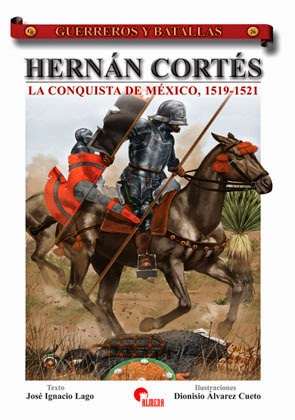
Many years later, giving a stroll by the calle Real de Madrid, I found a little store specialized in military subjects. The cover of a book exposed in the showcase called my attention; “Hernán Cortés, the Conquest of Mexico, 1519-1521 " writing by Jose Ignacio Lago and illustrated by Dionisio Alvarez Cueto.
 
It is not necessary to say that I acquired and read it with avidity. Nor it is not necessary either to say that what there was narrated fascinated to me. There here the key and the resolute enigma! Although this just was the beggining of my own adventure , my own particular discovery. In my mind I recreates the fabulous city of Tenochtitlan, their bridges, their lagoon, their chinampas, their houses and their temples, their well made city grid, the handful of Spaniards who entered there, their fascination and greed, their confinement, their tricks, their fled! The fight for Tenochtitlan. To me it was as to read a book of adventures with hundreds visual and argumental possibilities. I flirt with the idea that someday it was put in images in the same way that I see in my mind while I read it. How had not been made this before? It was the germ of something would grow with time. 

And it was after some brief time that I took the Passuth's novel “The God Rain cries on Mexico”.
 
And in spite of interesting of the story the author had not managed to evoke in my mind the images that I had conceived of the subject. To me it lack claw, force in certain passages which left in me the necessity to look for something more that covered that emptiness. The conquest of Mexico was becoming a fixation that I had to solve. But thanks to Passuth this impulse was fortified and it impelled to me to continue investigating. 

Coming the Gibson's “Apocalypto” and the necessity to see the efforts of others recreating the ancient Mesoamérica, and its result, that I decided to make by myself that I was looking for. It was a call that had become a duty in a personal level. And even so they would not spend some years until I decided to buy a notebook and, pen in hand, take notes, annotations, make summaries, an organizational chart, organize chapters or subjects, and write the script of a six chapters graphic novel about the conquest of Mexico-Tenochtitlan. 


Of course that before seating to write I had to investigate more and collect data. This was the reason that from “Apocalypto” to the moment to put to write spent some years. Years of crisis in many aspects. And very good things also. Other projects had arose in the way, orders, changes, trips… During this time I'd  browse in Internet looking for bibliography and information. And between these could not  leave out  the contemporary sources. For that reason I ordered the two volumes of SARPE publishing house Bernal Diaz del Castillo chronicle and the “Letters of Relation” written by Cortés himself, thing that was a discovery.  

In the beginning I though just to keep a few versions and with this work on the text. But I realized that this will not enough, because each one constituted a very particular point of view and that if my intention were to be most impartial possible, and rigorous in equal measurement, to where it is allowed me and it been able, I'll needed to contrast the sources all the possible, not only from two ones, too from three, four, five, all points of view as I can in the way I get my own version of the Conquest. 

In this way my library on the conquest was growing and growing. Fell texts as that of Hugh Thomas, Montoya de La Rica, Richard Lee Marks, Leon Portilla,  Internet articles, documentary, and even comics, and other documents that would be exhausting mention here. All these texts showed surprising things to me that did I not know happened in this conquest; unsuspected passages, anecdotal events but revealing, key episodes, incidents that never were had counted, in short, an amalgam of things that began to give other dyes to the summarized and prejudiced vision that I had about the conquest from both points of view; the one who was defeated and the one who vanquish. 

 I wanted to tell the conquest structuring the story as most dynamic as possible keeping close to the historical facts, without fantastic deflections, without added deforming elements as is usual in the comics genre to show that the history itself contains so many surprising and interesting elements, and entertained if it is wanted, that it does not need more. All this fortified me in the idea to take to term my comic book and show it to you like a graphic and divulging work. One thing is to read about the subject in an academic text and very different other is to see it in images. Therefore the script and the cartoons went expanding until arriving at twelve chapters from around 40/50 pages each one. And leaving many things outside!   

***
Muchos años después, dando un paseo por la calle Real de Madrid encontré una tiendecilla especializada en temas militares. Me llamó la atención la portada de un libro expuesto en el escaparate; "Hernán Cortés, la Conquista de México, 1519-1521" escrito por José Ignacio Lago e ilustrado por Dionisio Álvarez Cueto.
 
No hace falta decir que lo adquirí y lo leí con avidez. Ni tampoco hace falta decir que lo que allí se narraba me fascinó. ¡He aquí la llave y el enigma resuelto! Aunque fuese solo el principio de mi propia aventura, de mi propio descubrimiento particular. En mi mente recree la fabulosa ciudad de Tenochtitlán, sus puentes, su laguna, sus chinampas, sus casas y sus templos, su bien realizado trazado, el puñado de españoles que entraban en ella, su fascinación y su codicia, su encierro, sus tretas, ¡su huida! La lucha por Tenochtitlán. Para mí era como leer un libro de aventuras con cientos de posibilidades visuales y argumentales. Coqueteé con la idea de que algún día se pusiese en imágenes tal y como yo las había concebido en mi mente mientras leía. ¿Cómo no se había hecho esto antes? Era el germen de algo que crecería con el tiempo. 

Y fue al cabo de algún breve tiempo que me hice con la novela de Passuth "El Dios de la Lluvia llora sobre México".
 
Y a pesar de lo interesante del relato el autor no había logrado evocar en mi mente las imágenes que yo había concebido del asunto. Para mi le había faltado garra, fuerza en ciertos pasajes los cuales dejaron en mi una más fuerte necesidad de buscar algo que cubriese ese vacío. La conquista de México se estaba convirtiendo en una fijación que debía resolver. Pero gracias a Passuth este impulso se fortaleció y me impulsó a seguir investigando. 

Llegado el "Apocalypto" de Gibson y la necesidad de ver el esfuerzo de otros al recrear la antigua Mesoamérica, y su resultado, decidí ponerme yo mismo a realizar lo que buscaba. Era una llamada que se había convertido en un deber a nivel personal. Y aun así no pasarían algunos años hasta que decidí comprar un cuaderno y, bolígrafo en mano, tomar notas, apuntes, hacer resúmenes, un organigrama, organizar capítulos o temas, y escribir el guión de una novela gráfica de seis capítulos sobre la conquista de México-Tenochtitlán.

Por supuesto que antes de sentarme a escribir tuve que investigar más y seguir acumulando información. Por eso que desde "Apocalypto" hasta el momento de escribir pasaron algunos años. Años de crisis en muchos aspectos. De cosas muy buenas también. De otros proyectos que surgieron en el camino, encargos, cambios, viajes... Durante este tiempo navegué por internet buscando bibliografía e información. Y entre estas no podían faltar fuentes contemporáneas al suceso. Por ello encargué los dos tomos de la editorial SARPE de Bernal Díaz del Castillo y las "Cartas de Relación" escritas por el mismo Cortés, cosa sorprendente para mí.
 
Esto lo hice porque al principio pensaba quedarme con unas cuantas versiones y trabajar mi texto basándome en ellas. Pero me di cuenta que no era suficiente, que cada una constituían un punto de vista muy particular y que si mi intención era ser lo más imparcial posible, y riguroso en igual medida, hasta donde se me permita y pueda, necesitaba contrastar las fuentes lo máximo posible, no ya desde dos puntos de vista, sino de tres, de cuatro, de cinco, de todas las posibles y sacar mi propia versión. 

Así mi biblioteca sobre la conquista fue creciendo y creciendo. Cayeron textos de Hugh Thomas, Montoya de la Rica, Richard Lee Marks, León Portilla, artículos en internet, documentales, e incluso cómics, y otros documentos que sería aquí fatigoso de enumerar. Todos estos textos me mostraron cosas sorprendentes que desconocía ocurrieron en dicha conquista; pasajes insospechados, episodios anecdóticos pero reveladores, claves, sucesos que nunca se habían contado, en fin, una amalgama de cosas que empezaban a dar otros tintes a la resumida y prejuiciada visión que tenía de la conquista desde ambos puntos de vista; la de los vencidos y la de los vencedores. Quería contar la conquista estructurando el relato de la forma más dinámica posible sin alejarme de los hechos históricos, sin desvíos demasiados fantásticos, sin añadidos deformantes propios del género para mostrar que la misma historia en sí contiene tantos elementos sorprendentes e interesantes, y entretenidos si se quiere, que no necesita más. Y todo esto me fortalecía más en la idea de llevar término mi cómic y mostrarla a los demás como un documento gráfico y divulgativo. Por que una cosa es leer sobre el tema en un texto académico y otra muy distinta es verla en imágenes. Por ende el guión y las viñetas se fueron dilatando hasta llegar a doce capítulos de alrededor de 40/50 páginas cada uno. ¡Y dejando muchas cosas fuera!

Sunday, June 22, 2014

About Conquistadores and Defeated, a brief introduction / Sobre conquistadores y conquistados, una breve introducción.

     An image is worth more than thousand words. It is a cliche that sometimes is certain. And an 
image that remain fixed in my retina, and my memory, was this; the Castilians catched within a sort 
of walls outside which mexica warriors  advance in column brandishing their arms.
 
 
     The image was part of a documentary one transmitted by the university television of Panama, my
country of origin. “The Spaniards were enclosed  and besieges within the Axayacatl's palace, without 
water, without sufficient food, harassed day and night in rain of stones, darts, arrows and war 
shouts". Or something thus was what narrated the voice in off accompanying this image. It is 
impossible that I remember exactly what I listened; I was very kid, we are speaking of early nineties, 
but that image and what illustrated was what it made an impression to me and leave me a mark.
It was a surprising revelation; listen words like "palace", "city", "walls" they did not fit with the
idea that I had of which they were the Indians in my own country; the idea that taught to us.
I was customary to see in text books, and the real life, quite simple and pacific natives, resigned
and until innocents. Their small villages are not cities and much less there were Stone palaces. In text
books of the school appeared the illustrations of the arrival of Chistopher Columbus to Guanahani
coast (San Salvador) been received by idyllic natives in loincloths approaching curious to the just
arrived with innocent air and a few arrows and arcs.
 

     And the bust portraits of the conquerors that shows hieratic pretensions mens with dense beards, 
elegant pose, invincibles, iconic look. How it was possible that natives in loincloths could corner the 
Spaniards, who had more sophisticated arms, in… a palace? In a palace inside of a city in the middle 
of a lake?
 

     And what about Machu Picchu? It is certain that the renowned city, iconic like the pictures
of the Conquistadores, was a case aside. For me particularly I associated it to a separated religious
center in mountains, a enigma tie to “gods came from the sky ", and not to a people with a complex
culture. Come on, don't blame to me, was the result of how they taught our history to us; fast
and with anecdotal dyes. The important was to learn the dates and the things that happened in
it. And everything at very local level. And my attention in those years was focus on learn Painting
and the Middle East and Western Art.
     Resume, that news contravened  my concept of to be conquered. To the concept that I had then, of
course. And simultaneously that revelation opened to everything a world of new sensations on the
matter. Fascinated to Me! But it remained there, sleeping. Neither I investigated more about it. Of
course that the history of the conquest of Panama was not the history of the conquest of Mexico,
although they share certain patterns of behavior, and we tends to generalize. By which I followed
my life at margin of the subject. 
     Peculiarly my contact with Mexico and highlights of their past history continued arriving to me very
subtly. And peculiarly another television program was the means by which I could hear as sonorous
names as Moctecuhzoma, Cuauhtemoc and Chapultepec in comedy key; the "Chavo del Ocho".
Although all this was in a very caricatured and anecdotal key, as the mention of "La Noche Triste"
(Sad Night)  or the torture of the last Aztec emperor episodes in the school chapter of this program.
Even so this was breeding ground for the things will come later. Those just mentioned names, those
events evoked between laughter became like a business card, a sign and an enigma for which at
the right moment I took the key and opened seals to discover a surprising historic past buried
below anecdotes, text books and already known.


***
     Una imagen vale más que mil palabras. Es un cliché que a veces resulta cierto. Y una imagen que
se me quedó grabada en la retina, y en la memoria, fue esta; los castellanos atrapados dentro de una
especie de muros fuera de los cuales unos guerreros mexicas avanzan en columna blandiendo sus
armas.
 
 
   La imagen formaba parte de un documental transmitido por la televisión universitaria de Panamá,
mi país de origen. "Los españoles quedaron cercados y sitiados dentro del palacio de Axayacatl, sin
agua, sin comida suficiente, acosados día y noche por lluvia de piedras, dardos, flechas y gritos de
guerra". O algo así era lo que narraba la voz en off acompañando dicha imagen. Es imposible que
recuerde exactamente lo que escuché; era yo muy chaval, estamos hablando de principios de los
noventa, pero esa imagen y su texto fue lo que me impresionó y me caló. Fue una revelación
sorprendente; escuchar las palabras "palacio", "ciudad", "cerco" no encajaban con la idea que tenía
de lo que eran los indios en nuestra propia tierra; la idea que nos enseñaron. Estaba acostumbrado
a ver en los libros de texto, y en la vida real, a unos indígenas bastante sencillos y pacíficos, resignados 
y hasta inocentes. Sus caseríos no son ciudades y mucho menos había palacios de piedra. En los libros
de texto del colegio aparecían las ilustraciones de la llegada de Cristóbal Colón a Guanahani
(San Salvador) recibidos por unos idílicos indígenas en taparrabos acercándose curiosos a los recién
llegados con aire inocente y con unas cuantas flechas y arcos.
 

     Y en los retratos de los conquistadores vemos hombres de tupidas barbas y aires hieráticos, de
busto, siempre bien puestos, invencibles, icónicos. 
 
 
  ¿Cómo era posible que unos indígenas en taparrabos pudiesen acorralar a los españoles, de armas
más sofisticadas, en un... palacio? ¿En un palacio dentro de una ciudad en medio de un lago?
 
     ¿Y Machu Picchu? Es cierto que la celebérrima ciudad, icónica como los retratos de los
conquistadores, era un caso aparte. Para mí particularmente lo asociaba a un centro religioso 
apartado en las montañas, un enigma vinculado a "dioses venidos del cielo", y no a un pueblo con
una cultura compleja. Vamos, no me culpéis, era el resultado de cómo nos enseñaron nuestra historia;
de pasada, rápido y con tintes anecdóticos. Lo importante era aprenderse las fechas y lo que
ocurrió en ellas. Y todo a nivel muy local. Y mi atención en aquellos años era sobre el arte y la pintura
occidental y el Medio Oriente. 
     Retomando, eso contravenía  mi concepto de haber sido conquistados. Al concepto que tenía
entonces, claro. Y a la vez esa revelación abrió todo un mundo de sensaciones nuevas al respecto.
¡Me fascinó! Pero se quedó allí, durmiendo. Ni investigué más ni supe más sobre el tema en
concreto. Claro que la historia de la conquista de Panamá no fue la historia de la conquista de
México, aunque comparten ciertos patrones de comportamiento, y uno tiende a generalizar. Por lo
cual seguí mi vida al margen del asunto. 
 
     Curiosamente mi contacto con México y pinceladas de su historia y pasado seguían llegándome
muy sutilmente. Y curiosamente otro programa de televisión fue el medio por el cual pude oír
nombres tan sonoros como Moctezuma, Cuauhtemoc y Chapultepec en clave de comedia;
el Chavo del Ocho. Sin embargo esto era todo muy caricaturizado y anecdótico, como lo de la Noche
Triste o la tortura del último emperador azteca en los episodios de la escuelita de dicho programa.
Aun así este factor fue el caldo de cultivo para lo que vendría después. Esos nombres solo 
mencionados, esos eventos evocados entre risas se volvieron como una tarjeta de presentación,
un signo y un enigma para que en el momento justo tomase la llave y abriera los sellos para descubrir
todo un sorprendente pasado sepultado tras las anécdotas, los libros de texto y lo ya sabido.