
Many years later, giving a
stroll by the calle Real de Madrid, I found a little store specialized in
military subjects. The cover of a book exposed in the showcase called my
attention; “Hernán Cortés, the Conquest of Mexico, 1519-1521 " writing by
Jose Ignacio Lago and illustrated by Dionisio Alvarez Cueto.
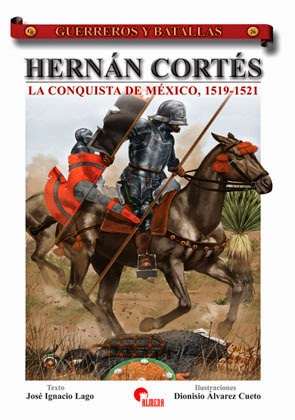
It is not
necessary to say that I acquired and read it with avidity. Nor it is not
necessary either to say that what there was narrated fascinated to me. There
here the key and the resolute enigma! Although this just was the beggining of
my own adventure , my own particular discovery. In my mind I recreates the
fabulous city of Tenochtitlan, their bridges, their lagoon, their chinampas, their
houses and their temples, their well made city grid, the handful of Spaniards
who entered there, their fascination and greed, their confinement, their tricks,
their fled! The fight for Tenochtitlan. To me it was as to read a book of
adventures with hundreds visual and argumental possibilities. I flirt with the
idea that someday it was put in images in the same way that I see in my mind
while I read it. How had not been made this before? It was the germ of something
would grow with time.
And it was after some brief
time that I took the Passuth's novel “The God Rain cries on Mexico”.

And in
spite of interesting of the story the author had not managed to evoke in my
mind the images that I had conceived of the subject. To me it lack claw, force
in certain passages which left in me the necessity to look for something more that
covered that emptiness. The conquest of Mexico was becoming a fixation that I
had to solve. But thanks to Passuth this impulse was fortified and it impelled
to me to continue investigating.
Coming the Gibson's “Apocalypto”
and the necessity to see the efforts of others recreating the ancient
Mesoamérica, and its result, that I decided to make by myself that I was looking
for. It was a call that had become a duty in a personal level. And even so they
would not spend some years until I decided to buy a notebook and, pen in hand,
take notes, annotations, make summaries, an organizational chart, organize
chapters or subjects, and write the script of a six chapters graphic novel about
the conquest of Mexico-Tenochtitlan.

Of course that before seating
to write I had to investigate more and collect data. This was the reason that
from “Apocalypto” to the moment to put to write spent some years. Years of
crisis in many aspects. And very good things also. Other projects had arose in
the way, orders, changes, trips… During this time I'd browse in Internet looking for bibliography
and information. And between these could not leave out the contemporary sources. For that reason I
ordered the two volumes of SARPE publishing house Bernal Diaz del Castillo
chronicle and the “Letters of Relation” written by Cortés himself, thing that was
a discovery.

In the beginning I though just
to keep a few versions and with this work on the text. But I realized that this
will not enough, because each one constituted a very particular point of view
and that if my intention were to be most impartial possible, and rigorous in
equal measurement, to where it is allowed me and it been able, I'll needed to contrast
the sources all the possible, not only from two ones, too from three, four, five,
all points of view as I can in the way I get my own version of the Conquest.

In this way my library on the
conquest was growing and growing. Fell texts as that of Hugh Thomas, Montoya de
La Rica, Richard Lee Marks, Leon Portilla,
Internet articles, documentary, and even comics, and other documents
that would be exhausting mention here. All these texts showed surprising things
to me that did I not know happened in this conquest; unsuspected passages,
anecdotal events but revealing, key episodes, incidents that never were had
counted, in short, an amalgam of things that began to give other dyes to the
summarized and prejudiced vision that I had about the conquest from both points
of view; the one who was defeated and the one who vanquish.
I wanted to tell the conquest structuring the
story as most dynamic as possible keeping close to the historical facts,
without fantastic deflections, without added deforming elements as is usual in
the comics genre to show that the history itself contains so many surprising
and interesting elements, and entertained if it is wanted, that it does not
need more. All this fortified me in the idea to take to term my comic book and
show it to you like a graphic and divulging work. One thing is to read about
the subject in an academic text and very different other is to see it in
images. Therefore the script and the cartoons went expanding until arriving at
twelve chapters from around 40/50 pages each one. And leaving many things
outside!
***
Muchos años después, dando un paseo por la calle Real de Madrid
encontré una tiendecilla especializada en temas militares. Me llamó la atención
la portada de un libro expuesto en el escaparate; "Hernán Cortés, la
Conquista de México, 1519-1521" escrito por José Ignacio Lago e ilustrado
por Dionisio Álvarez Cueto.

No hace falta decir que lo adquirí y lo leí con
avidez. Ni tampoco hace falta decir que lo que allí se narraba me fascinó. ¡He
aquí la llave y el enigma resuelto! Aunque fuese solo el principio de mi propia
aventura, de mi propio descubrimiento particular. En mi mente recree la
fabulosa ciudad de Tenochtitlán, sus puentes, su laguna, sus chinampas, sus
casas y sus templos, su bien realizado trazado, el puñado de españoles que
entraban en ella, su fascinación y su codicia, su encierro, sus tretas, ¡su
huida! La lucha por Tenochtitlán. Para mí era como leer un libro de aventuras
con cientos de posibilidades visuales y argumentales. Coqueteé con la idea de
que algún día se pusiese en imágenes tal y como yo las había concebido en mi
mente mientras leía. ¿Cómo no se había hecho esto antes? Era el germen de algo
que crecería con el tiempo.
Y fue al cabo de algún breve tiempo que me hice con la novela de
Passuth "El Dios de la Lluvia llora sobre México".

Y a pesar de lo
interesante del relato el autor no había logrado evocar en mi mente las
imágenes que yo había concebido del asunto. Para mi le había faltado garra, fuerza
en ciertos pasajes los cuales dejaron en mi una más fuerte necesidad de buscar
algo que cubriese ese vacío. La conquista de México se estaba convirtiendo en
una fijación que debía resolver. Pero gracias a Passuth este impulso se
fortaleció y me impulsó a seguir investigando.
Llegado el "Apocalypto" de Gibson y la necesidad de ver el
esfuerzo de otros al recrear la antigua Mesoamérica, y su resultado, decidí
ponerme yo mismo a realizar lo que buscaba. Era una llamada que se había
convertido en un deber a nivel personal. Y aun así no pasarían algunos años
hasta que decidí comprar un cuaderno y, bolígrafo en mano, tomar notas,
apuntes, hacer resúmenes, un organigrama, organizar capítulos o temas, y
escribir el guión de una novela gráfica de seis capítulos sobre la conquista de
México-Tenochtitlán.

Por supuesto que antes de sentarme a escribir tuve que investigar más y
seguir acumulando información. Por eso que desde "Apocalypto" hasta
el momento de escribir pasaron algunos años. Años de crisis en muchos aspectos.
De cosas muy buenas también. De otros proyectos que surgieron en el camino,
encargos, cambios, viajes... Durante este tiempo navegué por internet buscando
bibliografía e información. Y entre estas no podían faltar fuentes
contemporáneas al suceso. Por ello encargué los dos tomos de la editorial SARPE
de Bernal Díaz del Castillo y las "Cartas de Relación" escritas por
el mismo Cortés, cosa sorprendente para mí.

Esto lo hice porque al principio
pensaba quedarme con unas cuantas versiones y trabajar mi texto basándome en
ellas. Pero me di cuenta que no era suficiente, que cada una constituían un
punto de vista muy particular y que si mi intención era ser lo más imparcial
posible, y riguroso en igual medida, hasta donde se me permita y pueda, necesitaba
contrastar las fuentes lo máximo posible, no ya desde dos puntos de vista, sino
de tres, de cuatro, de cinco, de todas las posibles y sacar mi propia versión.

Así mi biblioteca sobre la conquista fue creciendo y creciendo. Cayeron
textos de Hugh Thomas, Montoya de la Rica, Richard Lee Marks, León Portilla,
artículos en internet, documentales, e incluso cómics, y otros documentos que
sería aquí fatigoso de enumerar. Todos estos textos me mostraron cosas
sorprendentes que desconocía ocurrieron en dicha conquista; pasajes
insospechados, episodios anecdóticos pero reveladores, claves, sucesos que
nunca se habían contado, en fin, una amalgama de cosas que empezaban a dar
otros tintes a la resumida y prejuiciada visión que tenía de la conquista desde
ambos puntos de vista; la de los vencidos y la de los vencedores. Quería contar
la conquista estructurando el relato de la forma más dinámica posible sin
alejarme de los hechos históricos, sin desvíos demasiados fantásticos, sin
añadidos deformantes propios del género para mostrar que la misma historia en
sí contiene tantos elementos sorprendentes e interesantes, y entretenidos si se
quiere, que no necesita más. Y todo esto me fortalecía más en la idea de llevar
término mi cómic y mostrarla a los demás como un documento gráfico y
divulgativo. Por que una cosa es leer sobre el tema en un texto académico y
otra muy distinta es verla en imágenes. Por ende el guión y las viñetas se
fueron dilatando hasta llegar a doce capítulos de alrededor de 40/50 páginas
cada uno. ¡Y dejando muchas cosas fuera!


